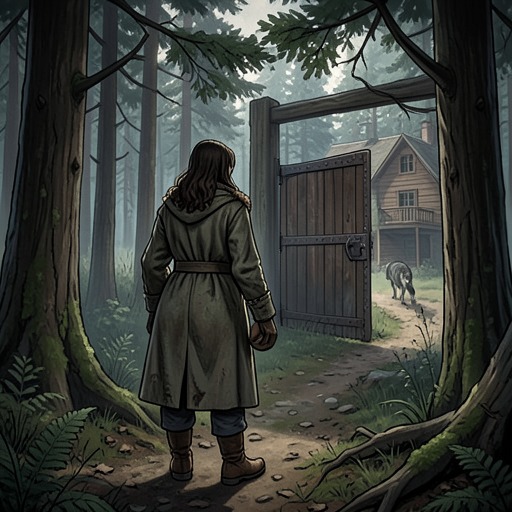
Meyers place
How to Flirt with A Naked WerewolfMeyers place is the small, isolated cabin that receives Mo Duvall-Wenstein at the beginning of her new life in Grundy. Chosen as an escape from a broken engagement, an unwanted career, and suffocating parental attention, it first appears to promise solitude and a forest view; in practice, it becomes a comic ordeal, a refuge, a meeting place, and a threshold between ordinary human life and the hidden werewolf community. The cabin’s changing meaning mirrors Mo’s own movement from deliberate isolation toward belonging.
Choice and Setting
Meyers place enters Mo’s life through the bare-bones Grundy website, which advertises hiking trails, guided hunting and fishing excursions, a “bustling economy,” and a single available rental. At six hundred square feet, the property contains one bedroom, a living room, a bathroom, and a kitchenette. Its decisive attraction is not comfort but the view from the front porch: the forest seems to offer the distance and wildness Mo wants after her broken engagement. She resigns from Gulfside Marketing and gives up her lease within a week, turning the cabin into the destination of an impulsive cross-country flight from Leland, Mississippi.
The location is both picturesque and radically secluded. Mo’s house stands fourteen miles outside Grundy’s town limits, half a mile from the highway at the end of a winding gravel driveway, surrounded by a silence so complete that she imagines an explosion could destroy much of Grundy without being heard. The mountains cup the valley, and the isolation initially feels like proof that she has escaped her former life rather than merely changed addresses. Yet the setting also exposes her to the region’s animals, weather, and secrets. The cabin is not a neutral retreat from society; it is positioned at the edge of the human settlement and the wilderness that conceals the black wolf.
Arrival and the Dead-Fish Housewarming
Nate Gogan, Grundy’s lone attorney, handles Mo’s rental and warns her that the property may not be ready. The Meyers had used it as a weekend hunting and fishing rental, and a party of fly-fishermen checked out only the previous morning. Gogan advises her to let the place “air out,” but after the long drive Mo refuses another motel and says that a little mess will not deter her. His hesitation proves justified. The exterior is charming and picturesque, while the interior resembles a condemned fraternity house: empty Doritos bags and dirty clothes cover the living room, furniture has been thrown around as if a wrestling match took place before the slate fireplace, and beer tabs hang from the kitchen light as an improvised decoration.
The cabin’s most memorable feature at arrival is its smell. Dead fish are piled in the refrigerator, placed in the bathroom sink, and hung from a string in the utility room. Mo spends her first hours in Grundy on what she calls the Great Dead Fish Hunt, double-bagging the remains rather than leaving them outside to advertise an all-you-can-eat buffet to bears. The disgusting labor establishes the cabin as a place that must be actively reclaimed before it can become home. Gogan’s embarrassment, Lynette’s absent cleaning shift, and his attempt to flick mildewed underwear through the door add local comedy, but they also show that Mo’s new dwelling is handed over through an informal network of imperfect community care rather than through polished institutional service.
Gogan does provide a more generous welcome: Tupperware containing Gertie Gogan’s famous pot roast, potatoes, and berry cobbler. The meal acknowledges that Mo should not have to cook after driving so far and gives her a first, indirect connection to Grundy’s residents. When Gogan offers to help unload boxes and Mo declines because darkness is falling, the cabin becomes the place where her independence is tested. She insists that she can clean it herself, while his eagerness to reassure her suggests that the town fears its rough welcome might drive away its newest resident.
Isolation, Reinvention, and Community
Once the fish are secured and the immediate chaos is contained, Meyers place becomes a private laboratory for Mo’s attempted reinvention. Wrapped in Yaya Wenstein’s quilt, she mentally rearranges the furniture, plans future meals, lists what she must buy and unpack, and imagines long nights of uninterrupted sleep without her parents’ constant calls. The cabin gives physical form to her hope of becoming happy, or at least content, through distance and self-direction. Its smallness is initially reassuring: unlike the social pressure she has fled, the house can be inventoried, cleaned, arranged, and controlled.
That control is repeatedly interrupted by the relationships the cabin draws toward it. Evie DuChamp sends Cooper Graham to offer help hauling Mo’s elliptical trainer from the garage, converting the domestic chore into an awkward introduction and an early stage for their mutual attraction. Mo has not actually asked for a match, but Evie’s intervention makes the cabin a bridge between the newcomer and the town’s social life. Mo later recognizes that her work at the Blue Glacier Saloon gives her privacy while placing her near friendly voices, chatter, and Evie; the cabin remains her retreat, but no longer represents complete withdrawal.
The contrast between home and community is central to the location’s development. Mo moves to Grundy intending an idle, solitary existence, yet the cabin’s isolation makes every visit, offer of help, and return from town more meaningful. Her connection to Evie, her growing relationship with Cooper, and her increasing participation in local affairs all begin against the backdrop of a home that was supposed to keep the world out. Meyers place therefore does not simply shelter Mo from society; it becomes the secure base from which she enters it.
The Wolf at the Threshold
Meyers place is also the first site where Mo’s ordinary categories of safety and danger collapse. Shortly after arriving, she wakes to frantic animal noises and finds an injured elk less than twenty feet from the door, with the largest black wolf she has ever seen hunched over its body. The scene places predation directly at the cabin’s threshold: the porch is not a firm boundary separating domestic life from the wilderness, but a narrow ledge between them. The wolf’s presence becomes the central mystery associated with the house and prepares the later revelation that Cooper is a werewolf.
Cooper’s human form reaches the same threshold in an even more shocking way. He appears outside Mo’s door naked, injured, and asking for help, with a bear trap clamped around his ankle. Mo recognizes the danger of admitting a stranger, yet his pain and vulnerability make her want to protect him and understand why he has come to her house. After she helps him, she falls asleep on the couch and dreams of running through the woods toward something waiting deep among the trees. When she wakes, a large black wolf is curled on the rug inside the cabin. The impossible animal has crossed from the forest into the private room, turning Meyers place into the literal interior of the mystery.
The cabin consequently serves as a threshold space in more than a geographical sense. Cooper’s repeated movement between injured man and wolf challenges Mo’s assumptions about what can enter a home and what kind of person can claim refuge there. Evie later explains that Cooper comes from a transforming werewolf line while her own family is a dead line, and that Cooper was expected to become the alpha before leaving the packlands for Grundy. The information makes the cabin’s earlier scenes newly legible: the wolf outside, the wounded visitor, and the animal inside are not unrelated disturbances but stages in Mo’s discovery of the hidden social order surrounding her home.
A Shelter Within the Larger Conflict
As danger spreads through Grundy, Meyers place remains associated with protection but cannot remain untouched by the town’s conflicts. Mo’s confrontation with John Teague leaves her traumatized; afterward, memories of his assault return through bodily sensations, images, and fear. Even after dead-bolting the cabin, drinking Sleepy Time tea, and putting on comfortable pajamas, she cannot settle. She sits on the porch under a quilt, watches a small black-tailed deer eat bread crusts, and scans the tree line for either her furry savior or the imagined ghost of Teague. The porch thus holds both recovery and vigilance: it offers open air instead of confinement, but the forest beyond it remains charged with possible threat.
The cabin also becomes the place from which Mo rebuilds agency. Unable to rest, she channels her manic energy into a detailed menu proposal for the Blue Glacier Saloon, researching recipes, costs, and shopping plans through the night. Her proposed comfort foods and expanded desserts help transform her from a newcomer into a worker with a recognized contribution to Grundy. The home that began as a site of filth and uncertainty becomes a workshop for the practical skills that secure her place in the community.
Later revelations connect the cabin’s private safety to the larger werewolf crisis. Cooper explains that the pack protects its village and families from wild animals, criminals, and other threats, but that he left after believing he had hurt many people through his decisions as a prospective leader. He also recounts his father’s death while trying to free Samson’s father from a research trap: the wounded wolf was shot in the head by researchers who did not understand what they were confronting. These histories deepen the meaning of the bear trap and the wolf at Mo’s door. What first looks like an eccentric emergency is linked to generations of violence, secrecy, scientific misunderstanding, and pack responsibility.
When Abner is found mauled near the campsite, Cooper fears that he may have attacked him while transformed and cannot remember it. He admits that he has no memory of the night, not even dreams or waking to check on Mo, and worries that he could have phased without waking her. The uncertainty turns the domestic trust established at Meyers place into a moral and emotional risk. The cabin is where Mo’s relationship with Cooper becomes intimate, but it is also where the consequences of his hidden nature press most directly against her sense of safety.
Lasting Significance
Meyers place is significant because it condenses the novel’s central movement from escape to attachment. Mo chooses it as an isolated refuge after abandoning her job, lease, and former engagement, but the property defeats the fantasy of clean separation almost immediately. Its dead fish demand labor; Gertie’s food introduces local hospitality; Evie’s matchmaking brings Cooper to the door; and the black wolf turns the surrounding wilderness into a source of both fear and revelation.
By the time Cooper continues visiting the packlands more often after Eli’s loss and Maggie Graham is elected alpha through a secret ballot, Meyers place has ceased to be merely a rental. It has become the domestic center of Mo’s new network, the place where she can shelter, plan, recover, and receive the people and secrets that reshape her life. Its importance lies in this contradiction: the cabin promises isolation, yet every decisive stage of Mo’s belonging begins when the outside world crosses its threshold.